The Translation
Gap
“Why We Mistranslate the People We Love”
I'm standing in the doorway to the garage.
My wife walks past.
"The garage needs cleaning."
"Okay."
She keeps walking. I go back to what I was doing.
"You said you'd do it."
"I never said that."
"You said 'okay'!"
"I was just acknowledging what you said. I didn't agree to do anything."
"Why would I tell you the garage needs cleaning if I wasn't asking you to clean it?"
"I don't know — maybe you were just... observing?"
We weren't having a miscommunication. We were having a mistranslation.
Same words. Different languages.
"They didn't misunderstand you. They understood perfectly. In their language."
We Were Speaking Different Languages.
In English.
There's a Korean reality show where a contestant said: "There are as many languages as there are people in the world."
We all speak English. But we don't speak the same English. Every word you use has been shaped by your childhood, your trauma, your culture, and your past relationships.
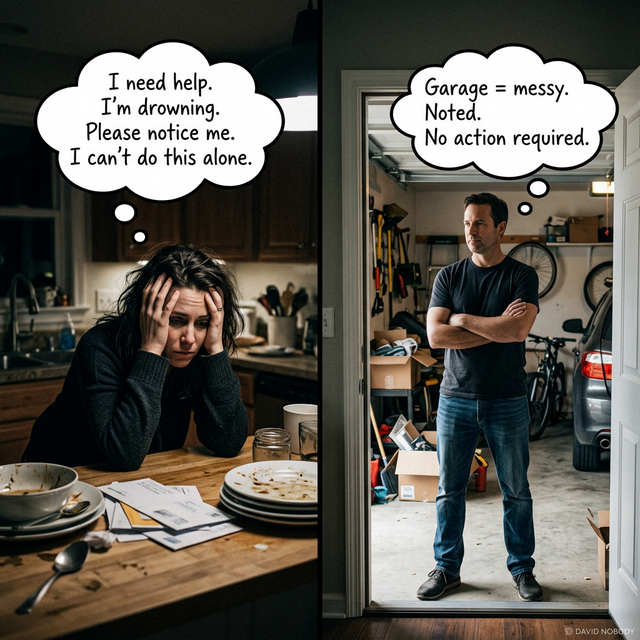
Visualization 04.1 — The Translation Gap Architecture
"The garage needs cleaning."
"I'm overwhelmed. The house feels chaotic. I need help. I'm asking you to notice I'm drowning and do something."
"The garage needs cleaning."
"Factual observation. Noted. Filed under 'things that are true.' No action required unless explicitly requested."
Three Reasons We Mistranslate.
We Have Different Dictionaries
Every word in your vocabulary has an emotional definition that was written in childhood. If "fine" in your house growing up meant "the fight is over and we're pretending it didn't happen," that's what it means to you now.
VERSION A
Dictionary A — "Everything is okay. I'm content. No problems here."
VERSION B
Dictionary B — "I'm furious but I'm not going to say it. You should know what you did wrong."
Your Personal Dictionary.
Select a word to see how its meaning changes depending on the childhood dictionary you grew up with.
"Fine"
- Everything is okay
- I am content
- No problems here
- Situation resolved
Learned in a household where "fine" genuinely meant fine.
"Fine"
- I am furious
- You should know what you did
- This conversation is over
- I will bring this up later
Learned in a household where direct anger was unsafe, so "fine" became the shutdown word.
The Translation Gap: 3 Case Files.
"Do you think you can get this done by Friday?"
This is genuinely optional. He's asking if I'm capable, not requiring me to do it.
I need this by Friday. This is a deadline disguised as a question to sound less demanding.
Direct language: "This is due Friday. Please prioritise it."
Sarah doesn't prioritise it. Friday comes. Manager is furious. Sarah is confused.
The
ADHD Layer.
ADHD brains handle social information differently. The gap isn't just childhood dictionaries — it's raw processing mechanics.
If you have ADHD, or you love someone who does, this Gap requires even more patience. More checking. More direct language.
Cues Are Missed
The ADHD brain often fails to catch micro-expressions, tone shifts, and body language in real-time.
No Subtext Pickup
We hear the literal words. The emotional request or hidden need underneath often doesn't register at all.
Working Memory
We cut in or interrupt not out of rudeness, but because we're terrified of losing the thought before the other person finishes.
Predictive Gaps
When we zone out, the brain fills in the gaps with what it THINKS was said. It's usually a mistranslation.
Tools For Better Translation.
Check Your Translation
When a reaction hits hard, pause. Ask: "What did I just hear? Is that what they actually said?" Not always. Not even most of the time.
Wait — did she say she was angry, or did I just hear anger?
Ask What They Heard
Try this: "What did you hear me say?" Not in an accusatory way. In a genuinely curious way. Because they are often different.
What did you hear me say just then? — the most disarming question.
Name the Subtext
Instead of expecting people to decode your subtext, try being direct. It feels vulnerable, but they don't know. They're in a different language.
Not: "The garage needs cleaning." But: "I'm overwhelmed. Could you help?"
Assume No Malice
When they misunderstands you for the 100th time, remember: they're just translating. Using a dictionary given to them before they could read.
They aren't doing it on purpose. Just like you.